
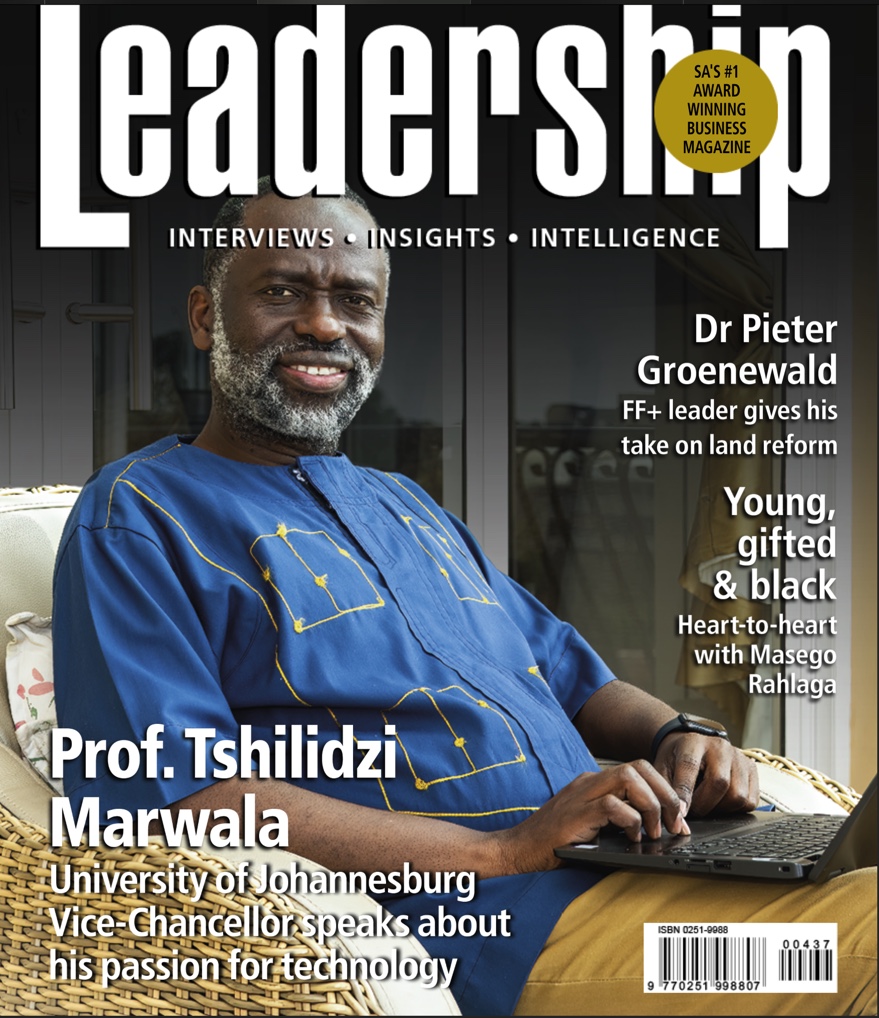
The Blindspot column, by Dr de Kock, in Edition 437 (May, 2022) of Leadership Online Magazine, engages with the dramatic global systemic changes engulfing the planet. Most significantly it traces the bifurcation of the global financial, and geopolitical/multilateral system as Economic War actions against the Russian Federation accelerates, and deepens integration in the Eurasian and Shanghai Cooperation Organisation domains.
To visit the LeadershipOnline current edition page, click on the cover image –>>
Sanctions against Russia, Eurasia integrates in response, with BRICS going for alternative to SWIFT
I – Sanctions against Russia & IMF warns – world financial stability at risk
As remarked in the April Blindspot column, market mayhem induced by the pandemic, and its global fall-out, just got much more complicated, since 24 February, 2022. The day the Russian Federation engaged in a military operation in Ukraine, after eight years of conflict raging on its border, inside the self-declared independent regions of Donetsk and Luhansk.
The world of globalised trade, finance, innovation, and what we believed to be the inevitability of increased integration, came to an abrupt end according to Larry Fink. Actions of economic war deployed, in response against Russia, is furthermore accelerating closer cooperation, while strengthening existing platforms of Eurasian intra- trade, investment, import, and export. What we are witnessing today is the bifurcation, or, division of the globalised system that dominated the post Cold War era.
This moment in history can be likened to a short sharp significant shock that created not merely an Iron Curtain 2.0 scenario with attendant images of Cold War. It can be argued that a great bifurcation of the world system is afoot, with Eurasia partly by force, but also informed by historical choice, emerging as coherent regional geopolitical construct, anchored in Moscow, Beijing, New Delhi, Tehran, the Shanghai Cooperation Organisation, and mechanisms of Eurasian regional integration.
These developments alone, already pose the question, how are South Africans to understand, and withstand the political-economic and strategic fall-out of these global dynamics, when the local state has been compromised, weakened, and its capability to act significantly undermined by years of mismanagement, state capture, and a shrinking economy?
With this in mind it is prudent to look into a dire warning from the International Monetary Fund (IMF), in its latest Global Financial Stability Report (April, 2022). In it the IMF argues that the Ukraine war has intensified a number of medium-term structural challenges policy makers will have to confront. In particular the IMF (p.ix-x) argue:
“The geopolitics of energy security may put climate transition at risk. Capital markets might become more fragmented, with possible implications for the role of the US dollar. And the fragmentation of payment systems could be associated with the rise of central bank digital currency blocs. In addition, more widespread use of crypto assets in emerging markets could undermine domestic policy objectives. Multilateral cooperation will remain key to overcome these medium-term challenges.”
II – Unpacking the IMF global financial system stability risks
As Larry Fink, President of BlackRock argued in March, the Russian invasion of Ukraine has put an end to the globalisation we have experienced over the last three decades. This statement is even more relevant, if seen in the context of the specific risks the IMF warns against, including:
- Fragmentation of capital markets
- Role of US dollar as global reserve currency challenged
- Fragmentation of global payment systems
- Rise of digital currency blocs
As observed above, economic war actions against Russia stirred an unexpected response, being Eurasian nations rapidly closing ranks while accelerating collaboration and integration. China and Russia have been, for a number of years, developing platforms to enable trade in national currencies, since 24 February this has been further enhanced, with India also trading with Russia in its national currency. This is the proverbial tip of the iceberg, seeing that members of the Shanghai Cooperation Organisation, including India, China, Russia, the Islamic Republic of Iran, and several other Eurasian nations, can now be seen as the backbone of a rising, integrating Eurasia.
Back to the risks outlined by the IMF it can be argued that economic war actions, sanctions, and isolation of Russia has already caused the fragmentation of capital markets. This is especially evident in the light of someone like Larry Fink’s prognosis of globalisation – as seeing its ‘end’ in the Ukraine war. This implicitly means that the days of unbridled capital markets with total global reach is all but over. Are we to expect the formation of ‘alternative’ capital markets? Most definitely yes, with the added dynamic of precious metals, like gold, being re-introduced as ‘standard’ against which the value of the Russian currency will be ‘hooked’. The latter poses an interesting challenge to fiat currencies ‘printed out of thin air’ by the European Central Bank, and the Federal Reserve.
In a world awash in fiat currency, and what seems to be ‘close to’ runaway inflation, the global financial system is not only at risk, but, the world is yet to ‘catch onto’ the fact that the global systemic reality has been altered fundamentally already. The IMF also warns about the role of the US dollar as global reserve currency.
In this context Wolf Richter, from Wolfstreet.com, indicates three important factors, being: 1. US Federal Reserve, and EU Central Bank Quantitative Easing (money printing) has already cost these nations dearly in the form of inflation (pre-Ukraine war); 2. Wolfstreet also indicates that in 2014 the US dollar accounted for about 66% of global reserve currency, by Q4 2021 its share as reserve currency dropped to just about 59%; 3. Wolfstreet also indicates that the purchasing power of the US dollar has been dwindling significantly, it is argued that the purchasing power of $100 in the year 2000, dwindled to $60.1 by 2022 – a significant loss of purchasing power!
III – What about BRICS?
Indeed, what about the BRICS? Towards the end of April, the BRICS grouping of nations, Brazil, Russia, India, China, and South Africa, indicated that they will be pursuing the creation of an alternative to the SWIFT global payment system. This is one more indicator that the risk of the fragmentation of global payment systems, is not an impending risk, it is a reality already. The BRICS nations make up about 42% of the world population, and with a global system forced into a moment of ‘bifurcation’ (in plain English – being torn in two) the BRICS creation of alternative to SWIFT is another sign of a world in significant turmoil.
The bifurcating global system is clearly moving in an even more intensified manner, in the direction of former President George Bush (jr.) period, characterised by, “You are either with us, or against us.” The only challenge is that the “Us” remains constant over time, while, as seen in recent months with the Russian Federation, the “Them” can very rapidly change to zoom in on other ‘candidates.’
There is clearly no easy solution to the foreign policy conundrum developing nations such as the BRICS, African, and Asian nations are facing, due to global nature of crisis, associated economic war, and direct/indirect impact of Russia-Ukraine conflict (markets and commodities from food, to fertilisers, energy, to weapons supplies for Africa thrown into turmoil).
The IMF furthermore warns that nations will face significant social shocks as food, fertiliser, and energy shortages (and inflation) bite. This means that not only is the world system bifurcating, but, internal social instability is likely to increase, as the world descends into a period of uncertainty, brought about by processes of change – the outcome of which is not yet clear. South Africa’s already fragile economy and society, and weakened state, stand to be challenged significantly as the fall-out from global systemic change come home to roost.